

As the world reflects on the one-year anniversary of the tragic Hamas attack on Israeli citizens in southern Israel—including the large-scale massacre at a music festival where hundreds of civilians were killed or taken hostage—most of us can’t begin to understand the unfathomable loss that took place (and continues to take place), and the deep suffering that has unfolded on both sides of the conflict. For many, this date signifies a day of terror, destruction, heartbreak, and despair, on both a personal and collective level.
However, from a soul-centered perspective, it also invites us to explore the depths of human experience, suffering, and the possibility of healing amid violence and hatred. Soul-centered psychology, based on Jungian, Transpersonal, Archetypal, and Depth psychologies, as well as on many ancient wisdom traditions, offers the perspective that within every moment of crisis lies an opportunity for deeper insight into the human condition, a way to find meaning and cultivate healing on a personal and collective level.
The events of that day shattered lives, incited grief, and left scars that run deep across both Israelis and Palestinians. Yet, even in the shadow of tragedy, the soul invites us to explore our responses and actions, asking: How do we respond to such events, both internally and outwardly? How can we engage with the trauma in a way that leads toward healing and not toward further destruction?
The Collective Shadow at Work
From a Jungian perspective, acts of terror can be seen as manifestations of the collective shadow, which Jung described as the darker, unconscious aspects of the human psyche that, when ignored or suppressed, erupt in violence and destruction. Part of our experience of the human journey—as souls incarnated in physical form—requires each of us to experience traumatic events over the course of our lives so that we can birth ourselves out of ignorance and fear the ego has adopted to try and deal with distress, and forward into greater consciousness.
Using a soul-centered lens, we understand that the attack by Hamas is not just an isolated event of violence but a reflection of deeper wounds that exist within and between societies. These collective traumas often arise when generations of fear, anger, and disconnect from Soul (both individual and collective) have taken hold, leading to acts of violence that reverberate through families, communities, and even entire nations.

One of the essential teachings of soul-centered work is the idea that healing begins with acknowledging the pain—not just at the surface level, but at its deepest roots. The horrific loss of lives, the trauma of the emotional scars, and the displacement of countless individuals from homes and lives all represent fragments of a collective soul wound that can’t be ignored.
Violence is never a solution, and when we respond to any tragedy or crisis at the same frequency through which it was initiated, we perpetuate unconsciousness and escalate objectification and discord. Therefore, engaging with our pain at the level of soul requires a shift from blame and retribution toward compassion, understanding, and the difficult but necessary process of grieving.
How Do We Heal?
As we honor the lives lost on both sides of the conflict, we also have to grapple with how to move forward, how to rebuild connections, and how to create a space where the soul can thrive again, allowing individuals within a society—and the society as well—to evolve and grow.
Healing a collective trauma requires a balance of both personal and communal introspection. While leaders and politicians debate the future, the individual soul can begin its healing journey by fostering compassion, dialogue, and a deeper understanding of the “other,” embodying self-love, and recognizing that our lives and our fates are interconnected. Those who are on a soul-centered path also recognize that we can hold space for the unfolding, potentially helping others to ground and center instead of being caught up in panic and despair.
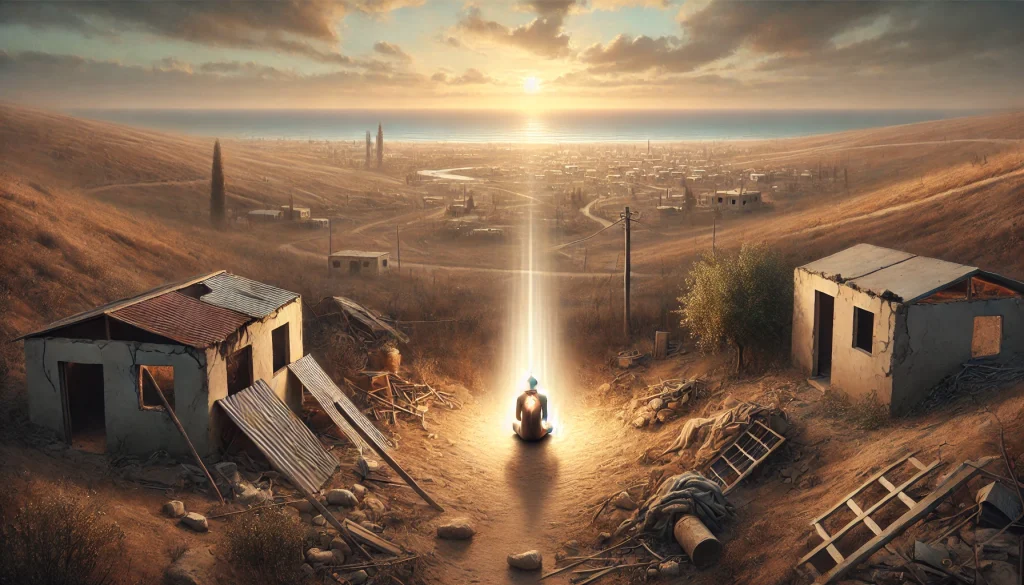
In moments of reflection, it is essential to turn inward and ask ourselves: Where have we lost touch with our humanity? What part of ourselves do we need to reclaim in order to foster peace, even when surrounded by violence? How can we begin to recover the lost pieces of our individual and collective soul, and re-member ourselves in a new configuration that promotes peace, productivity, and a sense of meaning in life.
On this somber anniversary, Soul calls us to honor the complexity of human life and death, to bear witness to the suffering, and to find ways to nourish the collective spirit. Whether through acts of remembrance, ritual, dialogue, or inner healing, we can strive to create a world where the wounds of terror are met not with more hatred, but with the balm of compassion and the potential for transformation. If we each connect deeply with our own soul, we can make a difference! I invite you to take a few minutes today to sit with your deep self, listening, learning, and loving what is in our complex human experience.
About Bonnie Bright, Ph.D.
Bonnie Bright, Ph.D. holds M.A. degrees in Psychology from Sonoma State University and Depth Psychology from Pacifica Graduate Institute, where she also completed her doctorate. She is a certified Archetypal Pattern Analyst™ and Transpersonal Soul-Centered Coach, using Somatic, Symbolic, and Shamanic perspectives to guide clients through spiritual awakening, integrate mystical experiences, and overcome creative blockages. She founded the Institute for Soul-Centered Psychology and Coaching™ in 2020. Bonnie is accredited through the International Association of Coaches, Therapists, & Mentors (IACTM) and has extensive training in dream work, Holotropic Breathwork, and the Enneagram. She also completed a 2-year training in Indigenous African Spiritual Technologies with elder Malidoma Somé, has lived with indigenous Shipibo people in Peru as part of a shamanic initiation to learn medicine and healing modalities , and has worked with shamans and healers in the Africa, and North and South America. In 2010, she founded Depth Psychology Alliance™, an online organization with over 5,500 members, and served as Executive Editor of Depth Insights™ journal for six years. Bonnie is the editor of "Earth, Climate, Dreams: Dialogues with Depth Psychologists in the Age of the Anthropocene" (2019) and "Depth Psychology and the Digital Age" (2016). Her journey into soul-centered work began with a mystical experience in 2006, which continues to inform her daily quest for awakening and helping others find their own path to soul.